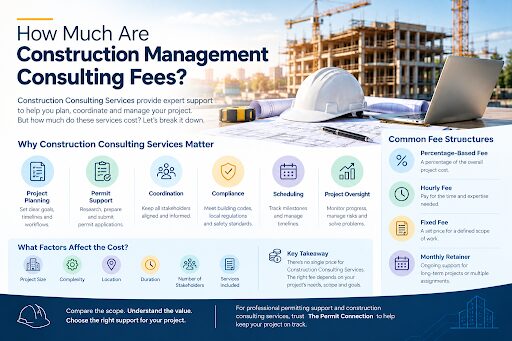
Construction management consulting fees can vary depending on the size, complexity, location, duration, and scope of a project. Some consultants charge an hourly rate, while others use a fixed fee, monthly retainer, or project based pricing structure.
For property owners, contractors, developers, and project managers, understanding how construction consulting fees work can make it easier to plan a realistic project budget.
Construction Consulting Services may cover a wide range of responsibilities, including project planning, permitting support, documentation, coordination, scheduling, compliance assistance, and project oversight. Because the scope can differ from one consultant to another, there is no single fee that applies to every construction project.
What Are Construction Management Consulting Fees?
Construction management consulting fees are the costs paid to a professional or consulting company for providing management, coordination, advisory, or specialized construction support.
The services included in the fee depend on the agreement.
A consultant might assist with:
• Project planning
• Construction coordination
• Permit research
• Permit applications
• Jurisdiction communication
• Scheduling
• Budget monitoring
• Documentation
• Contractor coordination
• Project reporting
• Risk management
• Construction administration
Not every consultant provides all of these services. That is why comparing the scope of work is just as important as comparing the quoted price.
How Much Do Construction Consulting Services Cost?
There is no universal fee for construction consulting.
The cost of Construction Consulting Services depends on the level of support required and the responsibilities included in the agreement.
A consultant handling only permit research may have a very different fee structure from a consultant providing comprehensive project management and ongoing coordination.
Factors such as project size, complexity, location, duration, and the number of services required can all influence the final cost.
For this reason, construction companies and property owners should request a detailed proposal that explains the services, deliverables, exclusions, and payment structure.
Common Construction Consulting Fee Structures
Construction consultants may use several different pricing models.
Percentage Based Fees
With a percentage based structure, the consultant charges a percentage based on the overall construction project value.
This approach may be used when the consultant is providing substantial project management or oversight.
The final fee can depend on the size and complexity of the project as well as the responsibilities assigned to the consultant.
Hourly Consulting Fees
Some consultants charge by the hour, particularly when the client needs limited or short term advice.
Hourly consulting may be appropriate for:
• Permit questions
• Project reviews
• Documentation assistance
• One time consultations
• Construction problem solving
• Preconstruction advice
This model can be useful when the scope of work is difficult to define in advance.
Clients should ask whether there is a minimum number of hours, a maximum billing limit, or additional charges for services outside the agreed scope.
Fixed Project Fees
A consultant may provide a fixed price for a clearly defined scope of work.
For example, a consultant might quote one fixed fee for:
• Permit research
• Application preparation
• A feasibility report
• Documentation review
• A defined consulting assignment
Fixed pricing can make budgeting easier because the client understands the agreed consulting cost before the work begins.
However, the scope should be clearly documented. If the project expands beyond the original scope, additional fees may apply.
Monthly Retainers
Some construction consultants work on a monthly retainer.
The client pays an agreed amount each month for ongoing consulting support.
Retainers may be useful for businesses managing multiple projects or clients who need continuing access to construction expertise.
The agreement should clearly identify:
• Services included
• Availability
• Reporting requirements
• Additional services
• Contract duration
• Communication expectations
What Factors Affect Construction Consulting Fees?
Several factors can influence the final cost of Construction Consulting Services.
Project Size
Larger projects generally involve more documentation, coordination, stakeholders, and management responsibilities.
A large commercial development requires a different level of management compared with a smaller renovation project.
Project Complexity
A straightforward project may require limited consulting support.
A complex project involving multiple buildings, phases, contractors, jurisdictions, or specialized systems may require considerably more involvement.
Project Duration
A consultant working with a project for a short period may charge differently from one involved throughout a longer construction schedule.
Longer projects can require ongoing meetings, reporting, coordination, and administration.
Scope of Services
The more responsibilities included in the agreement, the greater the potential consulting fee.
For example, permit research alone generally requires less involvement than comprehensive construction management.
Location
Construction requirements, local regulations, project conditions, and administrative processes can vary by location.
Projects in different cities or states may also require different levels of jurisdictional research and coordination.
Number of Stakeholders
Projects involving owners, developers, architects, engineers, contractors, subcontractors, inspectors, and government agencies can require significant communication and coordination.
A consultant may spend substantial time keeping information organized between these groups.
What Can Construction Consulting Services Include?
Before comparing fees, it is important to understand exactly what the consultant will provide.
Depending on the company, Construction Consulting Services may include:
Project Planning
Consultants may help identify project requirements, establish workflows, and organize important project information.
Permit Support
Permit related services can include researching requirements, preparing applications, coordinating submissions, and tracking jurisdiction comments.
Project Coordination
Consultants can help coordinate information between different project stakeholders.
Documentation Management
Construction projects generate substantial documentation. A consultant can help organize reports, applications, comments, revisions, and other project information.
Schedule Support
Some consultants help monitor milestones and identify potential scheduling issues.
Risk Identification
Consultants may help identify administrative, regulatory, scheduling, or coordination risks before they become larger problems.
The exact responsibilities should always be confirmed in the consulting agreement.
How to Compare Construction Consulting Proposals
When reviewing proposals, look beyond the final price.
Ask each consultant to clearly explain:
• What services are included?
• What services are excluded?
• How will the consultant bill?
• Is the fee fixed or variable?
• Are travel expenses included?
• Are additional meetings billed separately?
• What happens if the project is delayed?
• Are permit fees included?
• Are government fees included?
• How are additional services handled?
• How often will project updates be provided?
A detailed proposal makes it easier to compare different consultants fairly.
Are Permit Fees Included in Consulting Fees?
Clients should distinguish between consulting fees and government permit fees.
A consultant may assist with permit applications, but the actual permit fee charged by a city, county, or other jurisdiction is generally a separate project expense unless the agreement specifically states otherwise.
The same principle may apply to:
• Plan review fees
• Inspection fees
• Expedited review fees
• Engineering fees
• Architectural fees
• Third party review fees
Always check the proposal carefully so there are no unexpected costs.
Can Construction Consulting Services Save Time?
The purpose of hiring a consultant is not simply to add another expense to the project.
Professional consulting can help organize processes, identify requirements, improve communication, and reduce administrative problems.
For example, a project team may spend significant time researching local permit requirements, communicating with jurisdictions, tracking corrections, and preparing resubmissions.
If those tasks are handled by a qualified consultant, internal staff may have more time to focus on other project responsibilities.
However, no consultant can guarantee that a project will avoid every delay or unexpected cost. Construction projects are affected by many factors outside a consultant’s control.
When Should You Hire a Construction Consultant?
Consulting support may be useful before construction begins rather than after problems have already developed.
Consider consulting support when:
• You are unfamiliar with the project jurisdiction.
• Your company is expanding into new locations.
• Multiple permits are required.
• The project involves several stakeholders.
• Your project team has limited administrative resources.
• Permit requirements are complicated.
• You need help coordinating documentation.
• You are managing multiple projects simultaneously.
Getting support early can give the consultant more time to identify requirements and organize the permitting workflow.
Questions to Ask a Construction Consultant
Before working with a consultant, project teams should understand what services are included.
Useful questions include:
• Which jurisdictions do you support?
• Do you provide permit research?
• Can you prepare permit applications?
• Do you coordinate jurisdiction submissions?
• Do you track permit comments?
• Do you assist with resubmissions?
• How are project updates communicated?
• What documentation will you need from our team?
• Which responsibilities remain with our architect, engineer, or contractor?
Clear expectations can help ensure that everyone understands their role.
Conclusion
Construction management consulting fees depend on much more than the overall size of a construction project. Project complexity, duration, location, responsibilities, and the type of consulting support required can all influence the final cost.
Common pricing structures include percentage based fees, hourly billing, fixed project fees, and monthly retainers. Because every construction project has different requirements, clients should evaluate the complete scope of services instead of focusing only on the quoted fee.
When evaluating Construction Consulting Services, the most important step is to understand exactly what you are receiving. A clear scope of work, defined deliverables, transparent exclusions, and an agreed payment structure can make the consulting relationship easier to manage.
For contractors, architects, project managers, developers, and property professionals who need help navigating construction permitting and related administrative requirements, The Permit Connection provides personalized permitting support. From permit research and application preparation to jurisdiction submissions, comments, and resubmissions, The Permit Connection can help organize the permitting side of your construction project.
The right consulting arrangement should fit your project’s needs, budget, and complexity. By comparing the scope and services rather than focusing only on price, you can make a more informed decision about the type of construction consulting support your project requires.
Frequently Asked Questions
1. What are construction management consulting fees?
Construction management consulting fees are the costs associated with professional construction management, coordination, advisory, permitting, documentation, or project support services.
2. Do construction consultants charge hourly?
Yes. Some consultants use hourly billing for limited consulting assignments, short term advice, project reviews, or work where the scope has not yet been clearly defined.
3. Are fixed fees available for construction consulting?
Yes. A consultant may provide a fixed fee when the scope of work and expected deliverables are clearly defined.
4. What affects the cost of Construction Consulting Services?
Project size, complexity, location, duration, number of stakeholders, required services, and level of consultant involvement can all affect the fee.
5. Do consulting fees include permit fees?
Not necessarily. Government permit and plan review fees are generally separate from professional consulting fees unless they are specifically included in the agreement.
6. Can a construction consultant help with permits?
Yes. Depending on the consultant’s scope, services may include permit research, application preparation, submission coordination, jurisdiction communication, comment tracking, and resubmissions.
7. Should I compare multiple consulting proposals?
Comparing multiple proposals can help you understand available services and pricing structures. Make sure each consultant is quoting a similar scope so the comparison is meaningful.
8. Can construction consulting fees change during a project?
They can if the project scope changes, the project duration increases, or additional services are requested. A well written agreement should explain how changes and additional services are handled.